 You’re going to see this lie a million times in the next few days. I encourage you to ignore it.
You know what I’m talking about. It will be a post with an American Flag or a bald eagle or a picture of Mt. Suribachi, or some other patriotic image, with the same false claim: Land of the free, because of the brave. It’s a shout-out to the military and, while my respect for our Armed Forces is deep and resolute, the military isn’t the reason we’re the land of the free. Almost to the contrary, this is the land of the free because of the unassuming, the quiet, the principled and the courteous, the people who preserve our system by simply by accepting and defending its basis in fairness, flexibility, and majority rule. This country is the land of the free because we all agreed to think of democracy like a sport, with rules and winners and losers…and getting together for drinks after the game. And we agreed—or at least most of us agreed—that we’d abide by the rules and accept the outcomes because that’s the way life works. Sometimes you win and sometimes you lose, and, of course, there’s always next year. And there has always been next year for more than two centuries, which is a truly monumental achievement; even more monumental, in fact, because we didn’t ask for help from the military. As Ben Franklin told Mrs. Powel, we have, “A republic, if you can keep it.” Somehow, across nearly 250 years of mostly civil discourse, we’ve kept it without sending in the troops. We debated our neighbors and tried to sway them to see things our way, but we accepted the will of the majority whether we won or lost. We went to the polls and cast our ballots and either rejoiced or licked our wounds when it was over, and then we went back to our lives as if there was more to this world than politics. (Pro tip: There is more to this world than politics.) It’s an incredible leap of faith and civility to accept the will of the majority when you know the majority is a raving mob of idiots. It’s a magnificent display of humanity to recognize the failings of both your opponents and your compatriots, while according them equal honor as fellow citizens. It’s also an everyday thing, a constant that has sustained our freedoms more consistently and more successfully than any military intervention. Because, it’s such an everyday thing, we can forget it’s there for us to preserve, protect and defend it as if it were our birthright and our legacy. Which, of course, it is. And it’s not the military that preserves that legacy. In fact, it’s the opposite. If we need the military to get involved, we have relinquished the treasure that was passed on to our care and must be passed on again through our love of the sport known as democratic government. Protecting our legacy is getting tougher and tougher, largely because the sportsmanship ethos is fraying under the weight of Knute Rockne acolytes. The threat to our national cohesion is obvious and constant, with seemingly little awareness of the precious gift we’re squandering. And, of course, we won’t be able to replace it when its gone. We’ve called on our military only a handful of times to truly defend our freedoms, both overseas and across the Mason-Dixon line, and we can all be grateful for their successes on our behalf. Mostly, though, this is the land of the free because of everyday people who simply decided to make it so. Wishing all of them, all of us, the awareness and commitment, maybe even the bravery, to keep making it so this year and beyond. GBA.
1 Comment
 Over the next 36 hours, I’ll confess repeatedly to a crime I didn’t commit. Several, actually, although I’m starting to wonder if I might be an accomplice to at least a few.
The Days of Awe are racing to a close and, as always, I’m unprepared for an appointment that has been on the calendar for almost 3,500 years. It’s not that I’m unaware of the 10-day period of reflection that ends with our sealing in the Book of Life…or not…at the close of Yom Kippur tomorrow night. It’s just that I’m never ready to sit in on the test. Oh? You mean that’s today?? Our dates with destiny arrive without regard for our readiness, though, and I’ll find myself in the synagogue tonight and Monday, along with millions of Jews across the globe, confessing as a group to a gigantic list of sins. One of the confessional prayers is an acrostic, using all the letters of the alphabet to suggest we are guilty of transgressions from A to Z. Ashamnu, the name of the prayer, translates as, “We are guilty.” We abuse, we betray, we are cruel. Yeah, I guess I’ve done some of that over the past year. Then we get to the part about robbing and killing and, wait a minute, why am I confessing to stuff I’ve absolutely never done? The traditional explanation is that we confess as a community, connected and responsible in some way for each other’s failings. That means somebody in my synagogue is getting away with murder—so I definitely need to be nicer around them—while I have to shoulder some of their guilt. It all seems incredibly unfair, although they’re probably irritated at confessing to sins that I committed and they avoided over the past year. I guess it depends on how we keep score. On the positive side of the ledger, I frequently suggest that my charitable work has saved lives. I might not know where or how or whose, but I’m 100% certain someone is alive today, or will not be harmed tomorrow, as an indirect but inevitable result of my intervention. I don’t think much about the other side of the scorecard, the one where my action, or inaction, has led to harm. What if, like Peter Parker, my failure to act has made me an inadvertent accessory to murder? Okay, that’s overly dramatic and Uncle Ben was pretty old already, but there is a point at which the comparison is valid. It’s our choice to take action, but it’s also our choice when we take a pass. If I’m going to extrapolate from my few acts of charity to claim I am saving the world, it’s only fair that I take some heat for the paths I didn’t take. None of us can shift the earth’s axis on our own, but tipping the scales is always an option if we choose to act. Maybe I’m doing this right. Maybe I’m choosing life. Or maybe I’ve become complacent, coasting on an inflated sense of worth. Maybe I need to take another look at that list. Ashamti. If it turns out that I really am a murderer after all, you don't want to take the risk of ignoring my "suggestion" that you click here to subscribe. If you know what's good for you.  Question: When is an apology not an apology? Answer: When it’s on Facebook. This is the week when many of my Jewish friends post blanket apologies online as we sprint past Rosh Hashanah and race toward Yom Kippur. The Days of Awe are an intense period if you take it seriously, but all the religious rites are reserved for our relationships with God. When it comes to other people, any beefs have to be addressed directly with the individuals involved and there’s no prayer that lets us off the hook. That’s where all these Facebook apology posts arise, as our modern transgressors adopt a wholesale purge of guilt by saying oopsie online. “If you’re one of the people I’ve hurt in the past year, I’m sorry. If not, feel free to move on. And my work here is done.” I sympathize; really, I do. With so many aggrieved souls in our circles, the list of required apologies is endless. I have to apologize to Ed for being late and to Andrea for being too early; to Bill for ignoring his birthday and to Gwen for reminding her how old she is; to Stacy for calling too late at night and to Robert for waiting until the next day to give him the news. Maybe I can’t do anything right or, maybe, my contacts are simply looking for a reason to feel slighted. Either way, the tally of bruised psyches multiplies until it would take more than a decade to deliver all the groveling demanded from me. I understand the temptation to call on Facebook to deliver a simple, high-volume solution for pique response. Except that’s not how it works, and it’s not just my coreligionists who appear unable to offer a proper mea culpa these days. Nobody seems to know how to make amends, especially those sensitive souls who begin their pseudo-confessions with, “If I hurt you,” or “If I offended you.” If. “If you were hurt when I stole your car and ran off with your spouse and emptied your bank account and slandered your name all over the place, I’m sorry. Of course, you’re way too sensitive about the whole thing and it was really not that big a deal. But, if it bothers you so much, then I’ll be the bigger person and apologize. Are we good now?” Non-apology apologies seem to be the norm and not the exception, focusing on the fact that someone took offense and not on the offense itself. Does anyone know how to apologize for what they actually did? Apparently not. Maybe the problem starts with childhood, when parents tell their kids to, “Say you’re sorry,” without insisting that they actually be sorry. Maybe It’s the mantra that, “I’m a good person,” so anyone who is offended is sadly unaware of my kind and giving nature. Or, maybe, we’re just a bunch of selfish and insensitive jerks. A real apology is the most counter-cultural thing we can do, rejecting all the norms of our current age. There are no apps, no websites, no intermediaries or filters available to do it right. A real apology has to be direct, one to one. We have to speak directly to the person we’ve harmed, specify what we did, and express real remorse for our actions. Hard to believe, but most people actually did that a long, long, long time ago, at least when they weren’t dueling at dawn. It's much different now. Everyone’s offended about everything and, quite frankly, I’m just a bit offended at their insistence that I somehow owe them an apology for absolutely nothing. I’ll apologize to them after they apologize to me, first, and some anodyne disclaimer on Facebook ain’t gonna cut it. What else? Oh, yeah. To anyone who posted a generic apology on Facebook in the past year, please know that IF I HURT YOU by sharing my opinions, I am so very, very sorry. If I actually do owe you an apology, please send me a detailed message, including receipts and warranty cards, and I’ll get back to you right away. If not, just click here to subscribe and I’ll consider us even. 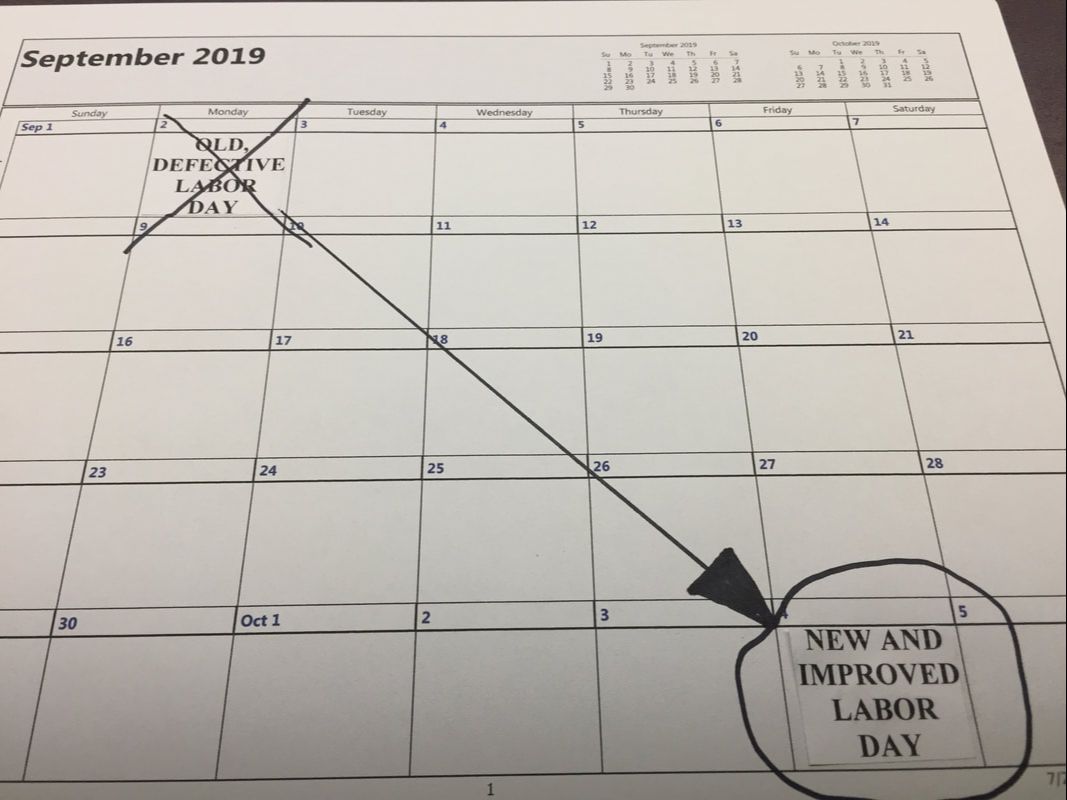 We haven't had a ton of traction since 2019, but that's only because of that whole "Covid" thing. It's time to get back to work and make Labor Day THE biggest issue of the 2024 Election Cycle. Forget global warming, inflation, abortion, and all those woke Chinese pandas at the National Zoo. This is the issue of our age, and it's not aging well.
Revived from September 1, 2019... All of us at Dad Writes are about to begin a national movement. It’s a movement that will gladden the hearts of all Americans and heal the wounds of our universe. This is the one common goal left to humanity in the internet age. We are divided irrevocably on pretty much everything, but we finally have a cause to unite us and restore our faith in each other. We must rise up in an unrelenting and ultimately victorious campaign to move Labor Day to October. As it stands, Labor Day is a depressing holiday, a last three-day weekend to mark the end of summer. Everyone slumps in their lawn chairs and talks about getting back to work while they complain that the fireworks were better on Independence Day. When it’s time for all the guests to leave, nobody talks about their plans for the week ahead, because everyone is planning to be in the office on Tuesday morning. Alas, what began as a celebration of the labor union movement has deteriorated into a celebration of Mondays. Yep, we get this one off, but then we’re working every Monday until MLK Day 21 weeks from now. But Labor Day can be much happier, and more apt, if we make the logical choice to move it back a month. The reasons are compelling and, dare we say, irrefutable. First, the equinox won’t come until September 23, this year, fully three weeks after we bury the season with a holiday marking the “official end of summer.” Insanity!!! Summer is a gift to treasure, not a curse to be canceled. Much like our participation trophies, regrets, grudges, and sixteen, we should hold onto summer as long we can. Second, the weather is going to stay summery well into October in most of the country, because that’s how weather works. Temperatures will still be warm, humidity levels will drop from their August peaks, and mosquito swarms will finally subside. We won’t notice it, though, because we all went back to work four weeks too early. What are we, nuts?? The sad reality is that September barbecues are never as relaxing or enjoyable as the same gatherings before Labor Day. Something is missing, and the missing ingredient is summer. We bury our best season prematurely at the start of September and then we just go through the motions. So sad. But when we move Labor Day to October, we can finally return the holiday to its rightful role as a celebration of working stiffs, the people who build the buildings and plant the plants and assemble the assemblies. We can transform Labor Day into an upbeat extension of summer, rather than its forced execution. “Yeah, the days are shorter now that it’s officially fall, but we have about two weeks left until Labor Day,” we’d say, and we would be happier as a result. When should the new Labor Day occur? We humbly propose the first Friday in October, which is the perfect date for a national holiday. Slotting Labor Day on a Friday will preserve the tradition of three-day weekends while dulling the sting of returning to work a few days later. At long last, people will have a real justification for all those TGIF memes. Admit it. This is such a great idea that you’re already wondering two things:
We understand how you feel. The brainstorming team at Dad Writes is very proud of itself for this earthshaking idea and we are fine with sharing the credit with all the fans who inspire us to be creative geniuses. Or genii. Or whatever. Enjoy your holiday and take heart. By this time next year, we will have achieved our goal and we will all be looking forward to another month of summer weekends. Be the first to know when the team at Dadwrites creates a new creation by subscribing to our weekly bursts of wisdom, humor and idiocy. Just click here and you’re on your way.  All my friends have been wishing me a happy new year, but it’s pretty clear they don’t really mean it. Let’s face facts here. If they really wanted me to have a happy new year, they’d have sent me a million dollars and a pizza. Ignore those glad-handers, though, because the folks at Dad Writes are sincere about this whole “happy” new year thing. That’s why we sent $1 million and a pizza to everyone who solved our super-secret, invisible riddle before midnight on December 31. And, for all of you losers who didn’t make the cut, we’ve put together a consolation prize, our guide to How to Have a Happy New Year Even if You Don’t Have $1,000,000 and a Pizza. Starting with…
Does this really have anything to do with my life? Spoiler alert: Roughly 99.9999999% of the time, the answer will be ‘no’ and you can continue on your merry way, enjoying a truly happy new year. Not quite as happy as it would have been with $1 million and a pizza, but happy nonetheless. Of course, the most important key to happiness in 2023, or any year, is to click here to subscribe to Dad Writes.  Even when I’m not sitting in my jammies and waiting for the Covid relief money to hit the bank, this is absolutely still my favorite week of the year. Once we’ve finished the sprint from Thanksgiving to Christmas, the pressure is off and there’s nothing to do but relax and feel grateful.
And, yippee, do I have a lot to be thankful for in my life? You bet I do. Yeah, there’s health and family and a roof over my head, yadda yadda blah blah blah, but this year in particular, I am grateful that…
Seriously, what more could a guy ask for from life? It can only get better from here. Let’s face it. Nobody’s going to return your calls or schedule a sales meeting or require your participation in some major strategic planning session this week. That means you have plenty of time to click here to subscribe to Dad Writes. |
Who writes this stuff?Dadwrites oozes from the warped mind of Michael Rosenbaum, an award-winning author who spends most of his time these days as a start-up business mentor, book coach, photographer and, mostly, a grandfather. All views are his alone, largely due to the fact that he can’t find anyone who agrees with him. Archives
January 2024
Categories
All
|
 RSS Feed